Showing posts with label italy. Show all posts

Wednesday, November 22, 2017

Another Phabulous Pharm in Phoenix - OK, I'll stop now. Phinally.

A view of the groves
“Former Detroit auto industry worker becomes olive farmer”
Isn't that a headline for the ages? Lucky for visitors to the area, That's exactly what Perry Rea did. After a period of study in Italy, the Rea family (wife Brenda and four and a half kids - Brenda was expecting) moved to Queen Creek (southeast Phoenix), planted olive trees and began their own business eleven years ago. Now, Queen Creek Olive Mill is a thriving concern, selling three grades of excellent quality olive oil, flavored oils, tapenades, and lots of other goodies, including beauty products (Olivespa) as well as edibles.
Olive oil lip balm, how do I love thee? Here in the desert, humidity is hard to come by – even in this fertile area, prunes not only grow on trees, but humans can turn into one with very little effort. The new line, created by one of the Rea kids, is fabulous.
Take the tour to find out how olive oil is made, the processes, differences in quality (you may never go to Safeway again), and how to really taste the stuff (hint: you warm it up before you swish it around). The Rea family has also published a pretty and practical take on Italian cooking with plenty of EVOO, of course.

Then order at the counter and wander out to the front shaded area to enjoy a tasty, inexpensive Italian-inspired meal among the groves: lunch every day, dinner on weekends. The Estrella pizza is sublime, the warm olives a meal in themselves. Good-sized portions, casual atmosphere and…most European of all… no tipping unless you force it on the busboys. It’s no wonder the Olive Mill has grown over the years and remains a local favorite.
We tried to leave some food on the plates, but it wasn't easy
The Olive Mill is not far from Schnepf Farm, so make a day of farm stops. Just try to avoid S. Rittenhouse Rd. during commute hours; The former 2-lane farm road hasn't kept up with all the new development in the area, and delays are unavoidable during those times.

Queen Creek Olive Mill
25062 S. Meridian Rd.
Queen Creek, AZ 85142

480-361-9860
https://www.queencreekolivemill.com/


Monday, June 10, 2013

The Netherlands and Italy. Jeez


typical Amsterdam street

I can’t imagine two cultures more diametrically opposed in the way they handle life. The Dutch are organized, clean, polite and very friendly in a formal way. Everyone looked healthy and prosperous. Ninety percent spoke English with an American accent. I never saw one beggar. Everything was right on schedule. Even the gentrifying neighborhood I slept in was clean and unthreatening. The weather was pleasant and cool, around 65 degrees at the high, and the sky often gray. And when my pocket was picked, it was in the Dutch manner—unobtrusive, quiet, elegant and thorough.

The "chicken-tickle" mosaic from Pompeii
Italians are laid-back, always a little later than scheduled (though everyone is held to the same loose strictures). The trains were mostly on time (I believe Mussolini had something to do with that). Helpful, yes, and very informal (I met Maria, one of my pedicureists on the street having a cigarette; she proceeded to tell me about her home and two young children). In Sorrento and other Amalfi coast cities, I got by easily with a mix of pidgin Italian and gesture—the result of plenty of English tourists. In Naples, it was a lot more difficult. Italy was mostly sunny, 75 degrees or more during the day. No pocket-picking, messy Italian style or any other way. The only poor I saw in Sorrento were foreigners, looking for work—and that was true of Naples, too—but Naples was in a bad way, and it was evident.

In spite of the Metrocart incident, I had to come home to really get robbed: a gift card I had set down with my purse and shopping bag next to me on the floor was stolen in my local CVS pharmacy. Interesting that the two most prosperous places I’ve been in lately—Amsterdam and Marin County—are the two places that host theives. I suppose Willie Sutton’s statement still holds true. When he was asked why he robbed banks, he replied, “That’s where the money is.”


See more images of Sorrento, Pompeii and Herculaneum on my website gallery page

Next: Southern Spain in July...

Tuesday, May 14, 2013

May 14 - Tuesday - Rick Steves at the Kebab Shop


Cathedral ceiling

I was at loose ends with what to do with myself today. I was sick to death of the Circumvesuviana train and didn't really want to travel anywhere so I chose to hang out. I decided to go to mass at the cathedral, as I wanted to get a look inside. I got there at 8:25AM, thinking there was a daily mass at half-past as posted, but nothing happened. I walked around and decided which saint I’d ask to intercede regarding the bout of blue lonlies that came upon me in the middle of the night (it only seems to happen in beautiful places, like Sorrento). That's the job of saints--they're go-betweens with influence. Then the bell rings and in walks the cardinal, all by himself--you can tell he was a cardinal by the red dress--and mass began. I didn't understand a word, but remembered well enough how it went from my childhood, and followed everyone else, up and down, kneeling and standing. I was really touched by his service and the way he held up the host (a thin bread wafer, for you non-Catholics) and wine--I could see that he really felt a transformation of the bread and wine into the body and blood of Christ.  It sounds horribly cannibalistic, but the idea is to become one with God, in imitation of the last supper.
"Magdalena" by Artemsia Tedelschi


After the service, I made an offering to Mary of Perpetual Mercy—she had her own little archway and fancy carved setting where she stood, life-size, embracing a little girl (so of course she would help me out). After, I wandered around town for a while and ended up at a somewhat funky museum with a nice garden and belvedere (a view out to sea). The museum was apparently the former home of some countess connected to the Grimaldis, and all her old artwork was on display. A lot of the paintings were so in need of restoration they were nearly black, but the clay figures of peasants in one display case was outstanding—full of emotion and expression.
Only nine inches tall, these figures are typical
of the intricate pieces many families collect
each year for their Christmas nativity scene.


I hung out in the garden, crossed the street to the lemon orchard, walked back into town--in the orchard, a lady was walking her very cute bunny, leashed with a chihuahua-sized harness. As I was making my way back to the hotel, a Sri Lankan man engaged me in conversation. He told me about his dream to open a hotel for tourists in a fancy new home he had bought (showed me pictures on his iPhone), and he was in Italy to work and make some money. He continued to chat me up, then suggested we pop into a nearby cafe to continue the conversation—that’s when I decided to take off. Maybe he was just lonely, missing the wife and son he said he left behind, or maybe he was hungry, as he hadn’t found work as yet. Who knows.

I first thought these were announcements of concerts
until I read them--they're public obituaries,
posted on boards all over town
Stopped in a cafe and spent time talking to a lovely couple from Minnesota. The wife confessed on the way out that the husband had injured himself severely in a motorcycle accident, whch ended their moto touring--they had traveled up Route 1 from San Francisco in the past, and had originally planned on touring the Amafi coast on motorcycles. She said, “after seeing how they drive here, I’m kind of glad we didn’t”. I couldn’t agree more. Driving in Italy is like roulette with large hunks of metal.

How cute are they! 
I came back and listened to a very long promo for a new age-y woman-empowerment seminar supposedly sent to me by a friend. A teensy bit of good info, a lot of jargon-based hype. Empowered, I decided to go out and get a pedicure. I went to a place nearby--it seems a lot of businesses in this town are owned by sisters, in this case, the Elegance Salon of Maria and Raffaela. It seemed like Raffela sanded a pound of dead skin off my feet--I didn t realize how crusty I truly was: All that hopping about dig sites in Pompeii and Herculaneum, not to mention the streets of Delhi and Jaipur, and the volcanic islands of the Galapagos.


How cute are THEY!
After, I popped down to the end of town and secured some more euros, just in case. On the way back, even though I had a ticket for a free drink courtesy of the pedicure sisters at a place called Bar Tiffany (it looked a little dangerous), I went for a falafel at the Kebab Shop--a tiny hole-in-the-wall on a street behind Corso Italo. Excellent kebabs and home-made pita, and pretty much the ONLY non-italian food in town.


Who should walk in but Rick Steves himself, with his Italian guide. I admire him: Rick Steves has managed to parlay a small set of self-written guidebooks into an empire. I went into schoolgirl mode and got all gushy, narrowly avoiding embarrassing myself and everyone else. I had my picture taken with him. Most of the time when you see someone like that, they're disappointingly short or creepy, but this guy was tall--over 6 feet, and a real sweetie. He was friendly, and it occured to me after (perfect timing) that he could probably use a little conversation with someone from home. Oh well.

The narrow alleys of Sorrento, early morning
See more images of Sorrento, Pompeii and Herculaneum on my website gallery page


Monday, May 13, 2013

Monday, May 13 - Pompeii


Pompeii's main square
Breakie at the hotel--a pretty good one, of which I shall make a habit. Then it’s on board the circum train for the bone-achingly long ride to Pompeii (it really wasn’t far, but the train stops at every tiny station on the line, stretching what would have been a half-hour ride into over an hour). I really didn't know if I wanted to make the effort to go to Pompeii, as I thought, "just more Herculaneum", but I was extremely glad when I got there. Spoke to a nice couple on the train--from Denver, where it was still winter when they left more than a week ago. They had gone to Amalfi, down the coast, and said it was terribly crowded and not much fun, so I scratched it off my list.

Vesuvius in the distance
Pompeii was and is an archeological wonder. Fantastic job of clearing centuries of hardened stone-like ash from a town that was smothered in a matter of hours 79 years after Jesus’ birth. This was a city--20,000 people wiped out just like that. The site is about twice or three times that of Herculaneum. The stone-paved streets still show the ruts from hundreds of chariot wheels.


Apparently the Pompeiians had no idea Vesuvio was a volcano, since it hadn't erupted in 1200-1500 years. A serious earthquake a few years prior to the 79AD eruption did some damage to the town's structures, and the repair work was left half-finished when buried in a mountain of ash. Much as I’d like to believe the official "instanteous death" line, the two plaster casts of the victims encased in glass in the market square do not look happy--they look in agony. I later found out they had died in the same way as the victims in the boathouses of Herculaneum: the pyroclastic flow swept over the town, causing suffocation. 

The first breath brought in superheated ash, which caused the lungs to fill with water. The second breath turned the inhaled ash to cement, and...there was no third breath, as the throat constricted and closed off the airways, so the citizens of Pompeii died very much like drowning victims.

Those ruts are from thousands of chariot wheels


Once again, I was astounded by Roman engineering, from the aquaduct and water system that flooded the streets every day to wash down the animal droppings to the large stones set in the roadways (conviently sized and spaced to accommodate passing chariots, all of which were built to the same specifications).


The famous faun (the original is in Naples) from the House of the Faun

On the return train, I was confounded by a stiuation. When the doors open to board the train, riders step into an empty entry compartment, and either go left or right to the compartments with seats. An older Chinese man and young girl had loaded on an enormous cart covered in plastic into the entry compartment, along with several large bags, also wrapped in plastic. When it came to their stop, they wrestled the cart off along with a couple of the smaller bags, and left the other large plastic bags on the train. Immediately my thoughts went to “bomb alert!”. As casually as possible, I moved away through the compartment to the next standing area (pa GAWK!—yes, I am a chicken)—which was also full of mysterious plastic bags. It was then I realized that people left their garbage on the train.

View of the harbor from Sorrento
Back to Sorrento after a full day, I ate at a perfectly terrible restaurant near the hotel--la felice. The calamari was adequate, but the service was impossible--I felt like the waiter was completely ignoring me. Wait, he WAS ignoring me, in favor of serving the Italian families first. No tip for him! I don’t recall how it was in Umbria or Rome the last time I was in Italy, but in Sorrento, you have to insist on paying people at the end of a meal; no one actually expects a tip and they seem genuinely surprised and grateful to get one. Quite charming.

See more images of Sorrento, Pompeii and Herculaneum on my website gallery page

Sunday, May 12, 2013

Sunday, May 12, Mother’s Day in the Ruins - Herculaneum


A Herculaneum fresco of Io and that randy shape-shifter, Zeus

Herculaneum, mid-way between Naples and Sorrento (the ruins are on the edge of a town, Ercola) is fronted by a beautiful public park, a six-block walk downhill from the train station. I took the Circumvesuviana train from Sorrento—crowded and dirty, it’s still the fastest way to get there. It was my plan to spend an hour or two at Herculaneum, then return to Pompeii (between Ercola and Sorrento) for the rest of the day on the way back. 


A delicate fresco in a bedroom
Herculaneum—a wealthy town much smaller than Pompeii with walking paths instead of chariot-wide streets--was hit by the volcanic gas cloud, ash and debris some hours after Pompeii, when the wind changed. Equally unprepared for the sudden onslaught of the six-mile high eruption of Vesuvius (ultimately releasing a hundred thousand times the thermal energy unfettered by the nuclear bomb the US dropped on Hiroshima, Japan at the end of WWII), many of the town’s inhabitants rushed to the sea to try to escape in boats; more than 300 skeletons were found in the boathouses on the shore. 


The people on the beach were overcome by superhot gas that cooked their internal organs instantly—those in the boathouses were not so lucky; the cloud of gas and ash--the pyroclastic flow—suffocated them.  I got the audioguide, and it was so good I ended up staying for four hours, and was completely worn out by sun and throroughly delighted by the wonderfully preserved ruins, the barking frogs in the pond that marked the former seashore, and the incredible mosaics in the women’s baths.


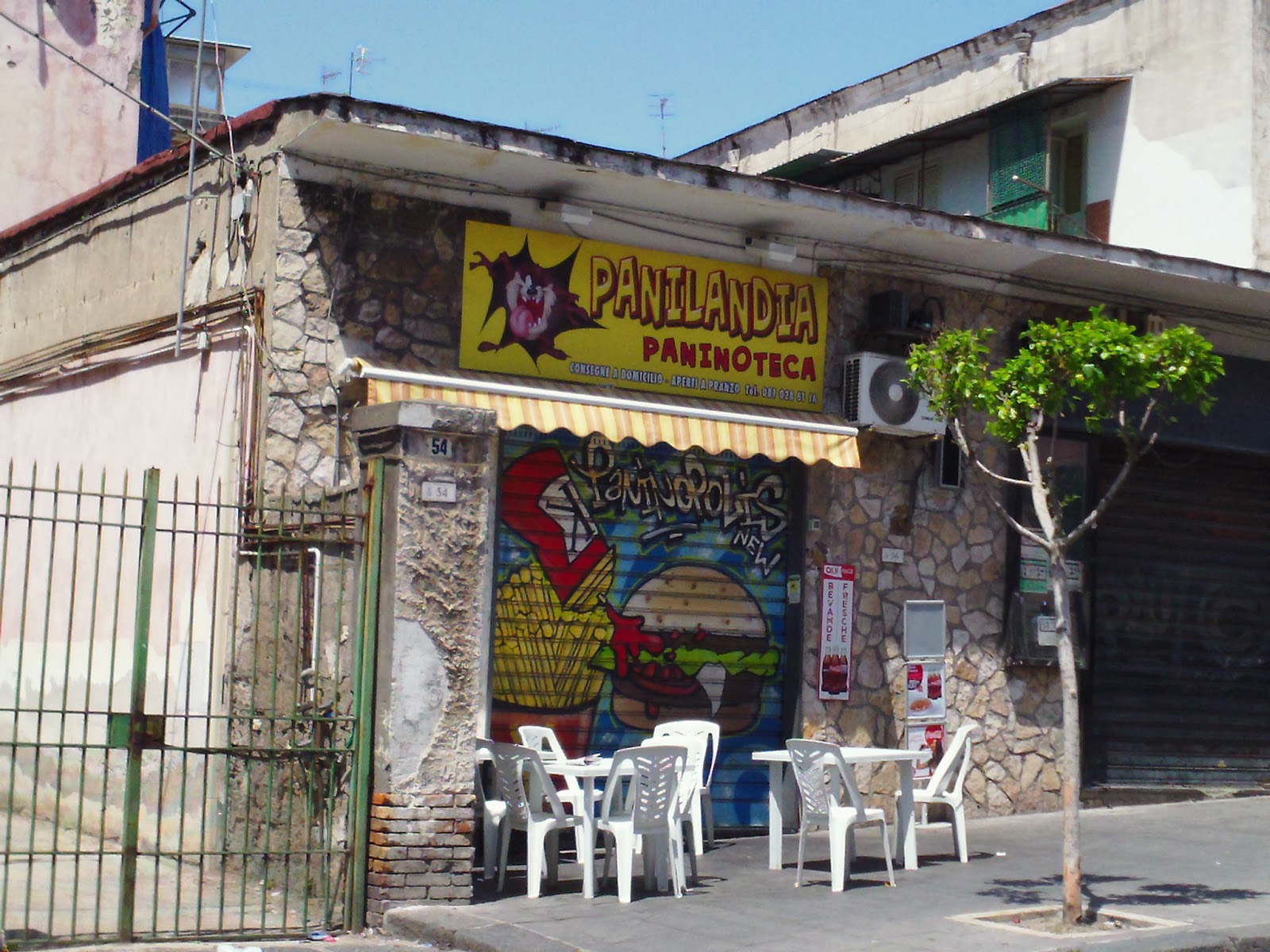
How about a snack at the Tasmanian Devil Panioteca?
Originally, I had planned to stay in Ercola, at the hotel across the street from the ruins. I stopped there for a fruit salad and freddo, a delciously sweet iced coffee with a milkshake-like consistancy (it’s pulverized ice, like a smoothie). The young waiter (with a black eye!) played on my sympathies by saying he worked two jobs and had no time to sleep—yes, I left a nice tip. I’m such a sucker. I’m glad I didn’t stay in Ercola, a working-class town that would have provided little of the excitement (and amazing views) of Sorrento. 

Graffitti outside a Circumvesuviana train station
On the crowded train back, I was standing, holding on to a post when I saw a young Italian woman, seated in the compartment on my left. She was pulling on her eye in a most peculiar way—tugging it into a slit. She continued to do it every time I glanced her way. When the train came to a stop, I wandered over there, and found an empty seat next to her; thanking her, I sat down. I later learned (thanks, Rick Steves!) that the eye-tugging meant to “watch out” or “pay attention”. I returned to the Marina Grande village and had dinner at the Five DiLeva sisters again. We were getting to be pals.

See more images of Sorrento, Pompeii and Herculaneum on my website gallery page


Saturday, May 11, 2013

Saturday May 11 - Amsterdam to Naples to Sorrento


Vesuvio on the way to Sorrento

I packed my back-pack with as many of the lighter-weight clothes I could stuff in and left my suitcase at luggage storage at the Amsterdam airport. An easy two-hour flight into what looked like a small airport followed (Naples airport is deceptive—it’s quite large); a tiny, stiff espresso at the counter powered me up for the half-hour wait for the Currieri Viaggi bus to Sorrento. During the wait, I sat on my back-pack, soaking in the sun, enjoying a 10 degree hike in temperature. The bus, modern and air-conditioned only cost 10 euros--the bargain of the century. The ride clung to the coast roads, and was absolutely spectacular. Tufa cliffs soar steeply from the sea, often 1000 feet or more. Homes, hotels and motley other structures are embedded into the cliffsides, cantilevered and precariously perched as if to dive in. This is earthquake country, and so much like home in some ways it’s reassuring.
Sorrento from above

Sorrento is Sausalito on steroids; the same sort of dwellings spill down into steep ravines, but many more of them. A lovely, lovely old town with narrow twisitng lava-stone cobble streets and archways, and likely a restaurant and shop per person. It’s crowded and commercial, yet never fails to be charming. Perhaps it’s the jewel-like setting.
My foresight in bringing only a backpack paid off when I got to the train station in Sorrento, where the bus dropped me off. The Hotel Ulisse was more than half-way across town, a good half-mile or more from the station. I got used to the walk, as I ended up doing it at least twice a day—thank goodness only twice with the heavily loaded backpack.

That night, I strolled on the narrow road from the Hotel Ulisse down to a little fishing village which is part of Sorrento and apart from it: Marina Grande. Dinner was  delicious; a perfectly cooked spaghetti pomodoro with fresh cherry tomatoes at the Five DiLeva Sisters restaurant (a tiny place with clear vinyl sheets for walls). 

The Five DiLeva Sisters


It was windy, but fun to watch the beautiful sunset and the people who live in this tiny village greet each other, the boats bob in the water, the stray cats search among the ropes and nets for morsels. 


A quiet evening in Marina Grande
When I returned to the hotel, I had planned to stay put; then I discovered that Sorrento had REALLY come alive. The town takes off after sunset, when it’s still warm and all the streets are lit, filled with tourists and regulars. I attended the main street passigiata, strolling the Corso Italo with everyone else, stopping by the peaceful convent of San Franchesco. I couldn't wait to explore more.


Courtyard of the convent of San Franchesco
See more images of Sorrento, Pompeii and Herculaneum on my website gallery page